After years of building and enjoying sauna, and talking with people who are buying their first one, a pattern keeps repeating.
Most people don’t make careless decisions. They research. They compare. They try to be thoughtful.
The mistake happens earlier than that.
They start by asking what’s easiest to buy, instead of what’s meant to last.
So they end up with something that technically works, but never really settles into their life. A few years in, it starts to feel temporary. Or compromised. Or already on its way out.
Sauna wasn’t always treated that way.
Mistake 1: Sauna is treated as a piece of workout equipment
Solution: Sauna as Architecture
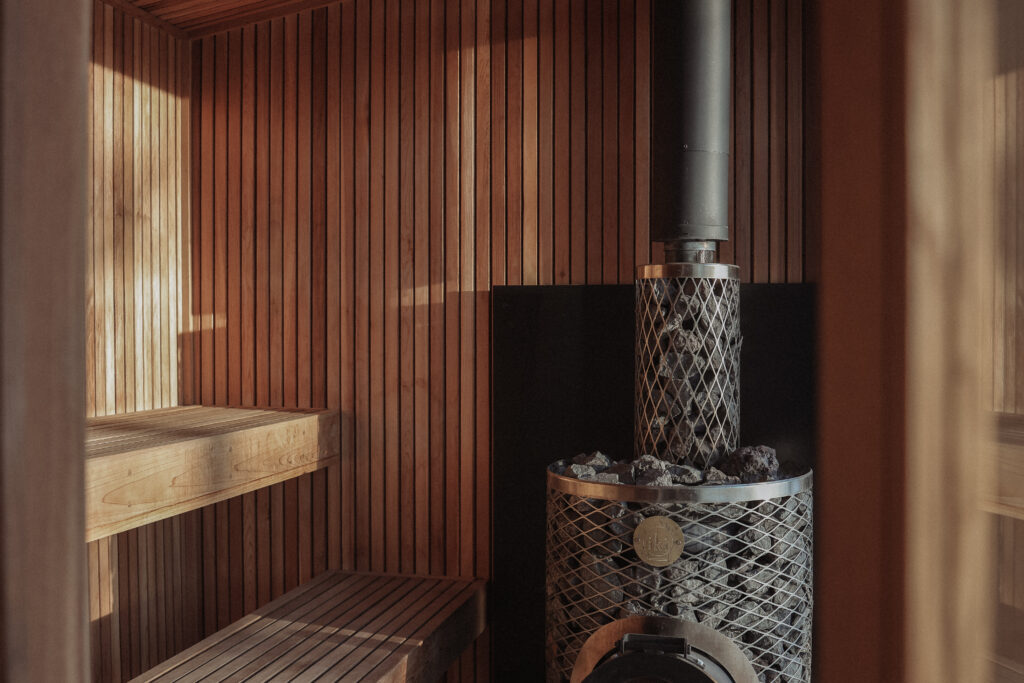
To us, saunas aren’t a product category. Many people new to sauna think about sauna as a piece of workout equipment because they find them at the gym.
Sauna done well is a long-lasting piece of architecture for your home and life.
Architecture should work, last, and be beautiful.
Historically, in Finland, the sauna was often the first structure built on a piece of land, sometimes even before the main house. It served practical needs, but it also carried cultural weight. It was used for bathing, for birth, for washing the dead. Because of that, it was built to stay.
Traditional Finnish saunas were built like log buildings, with thick walls and simple forms that could handle repeated heat, steam, and long winters without much intervention. The expectation was that the sauna would still be there decades later. That expectation shaped everything, from materials and proportions to how heat was allowed to move through the space.
That way of building never really went away in Finland. Barrels are rare there for a reason. Sauna is still treated as construction, not furniture, and that difference shows up immediately in how these buildings age.
Mistake 2: The allure of a cute and cheap barrel sauna
Solution: Design for heat and comfort
Barrel saunas look traditional to American eyes, but they’re not common in Finland. The reason isn’t taste, it’s performance.
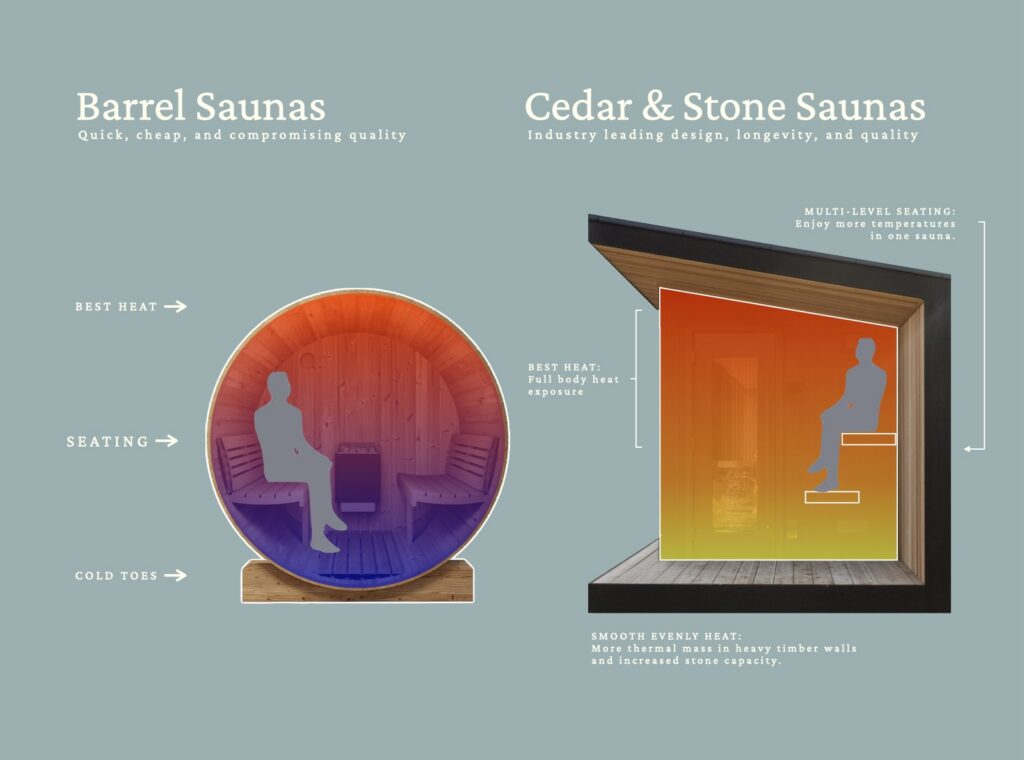
The shape works against how heat behaves in a sauna. Heat rises, and in a barrel it collects at the highest point of the curve, above where people sit. The result is a noticeable temperature gradient, with hot air at head level and cooler air around the feet. In Finnish sauna design, keeping the bather within the hottest part of the room has always mattered.
The curved walls also limit bench height and depth. You end up sitting lower, with less support, which changes how long and how comfortably you stay in the sauna. That’s not accidental in Finnish saunas. Bench height and proportions are intentional.
Structurally, most barrels are built from thinner staves held together under tension. Outdoors, those staves expand and contract with moisture and temperature changes. Over time, joints loosen and the shape shifts. In a climate with real winters, that matters. It’s one of the reasons you rarely see barrels where sauna has been built continuously for generations.
Mistake 3: Kit saunas, designed for delivery over durability
Solution: Build something that lasts
Kit saunas are another example of treating sauna as an object rather than a structure. They’re designed to ship easily, assemble quickly, and hit a price point.
It’s the wobbly IKEA end table, but expanded to a whole building on your property.
That approach is foreign to how sauna has traditionally been built in Finland. There, the assumption is that the building will deal with wind, snow loads, freeze-thaw cycles, and decades of use. That assumption changes how walls are built, how joints are handled, and how the structure resists movement.
Most kits rely on panel systems and lightweight assemblies. Panels flex. Heat distribution depends heavily on how precisely everything was assembled. Airflow is often secondary. In mild conditions, those compromises can go unnoticed for a while. In harsher climates, they can show up on day one.
Doors drift. Windows move. Fasteners work loose. The sauna still heats up, but the building carries stress it wasn’t designed to absorb. That’s not a defect so much as a mismatch between intent and environment.
Mistake 4: Falling for the infrared “sauna” hype
Solution: Reading the research, understanding the practice.
Infrared is where the language gap becomes the biggest.
Infrared creates more confusion than any other sauna option, mostly because of how it’s marketed. Much of the language used to sell infrared borrows directly from traditional sauna, especially around cardiovascular health, inflammation, and longevity. The issue is that most of the research behind those claims comes from studies on traditional Nordic sauna, not infrared.
That distinction matters.
Traditional sauna heats the entire room. The air is hot, the surfaces are hot, and steam is created by throwing water on stones. That environment produces a specific physiological response, and it’s that combination of heat, humidity, and duration that shows up in decades of peer-reviewed research out of Finland and Northern Europe.
Infrared works differently. Air temperatures stay much lower, often topping out around 105-140F, and heat is delivered directly to the body. There’s no steam, and the room itself plays a much smaller role. That doesn’t make infrared useless, but it does make it a different experience with a different mechanism.
That difference is acknowledged more clearly in Europe, where infrared units aren’t marketed as saunas at all. They’re sold as infrared cabins, and even safety standards treat them as a separate category. The naming reflects what they are and avoids borrowing credibility from a practice they don’t replicate.
| Feature | Finnish Sauna | Infrared Sauna |
| Heat Range | High Heat: 160-210°F | Low heat: 100-140°F, commonly |
| Thermal Mass | High thermal mass: 50-200 lbs of rock heated to radiate the heat slowly, and to pour water over to create soft steam. | Low/No Thermal Mass: Most infrared rooms have removed stone all together. Heating is directed to the body with infrared waves only, and not radiant or convective heat. |
| Materials | Natural Materials: Wood and stone as main building materials for longevity of structure. | Synthetic Materials: Most infrared cabins include plastics, glues, and other non-natural materials to integrate the panels into the room. This creates risk off gassing of those products while in use. |
| Water Drainage | Clean: Sauna has been used for centuries as a place to sweat, and to bathe. Making sure the space can handle water and proper drainage is essential. | Prone to Water Damage: Most infrared saunas are plug in and kit assembled which doesn’t often include thinking for proper water drainage, and with the electronic infrared panels it is often discouraged to use water in the space, breaking traditional cultural practices. |
| Steam Creation | Warm Comforting Steam: The ability to add water to the stones and manage your humidity, aromas, and feeling of the sauna. Plus, it feels like a healthy ritual. | No Steam: Infrared has removed this core ingredient. Without the steam it just isn’t a sauna. |
| Health Data | Science-Backed: Large, well-researched, conclusive medical data supporting the health impacts of traditional sauna. | Marketing Hype: Often cite research on traditional sauna to sell infrared modality. |
Some people enjoy infrared, and that’s fine. The problem comes when it’s sold as equivalent to a traditional Finnish sauna. When expectations are set by borrowed science, disappointment tends to follow.
Why our saunas feel better and last longer
A lot of modern sauna choices follow a familiar American instinct. We have a habit of taking things with deep cultural roots and simplifying them until they’re fast, cheap, and easy to sell. In the process, materials get thinner and longevity becomes optional. That works for many products. It doesn’t work well for buildings meant to live outdoors for decades.
We looked instead to Finnish sauna, where the assumption has always been that a sauna is built once and expected to last. That assumption changes everything.
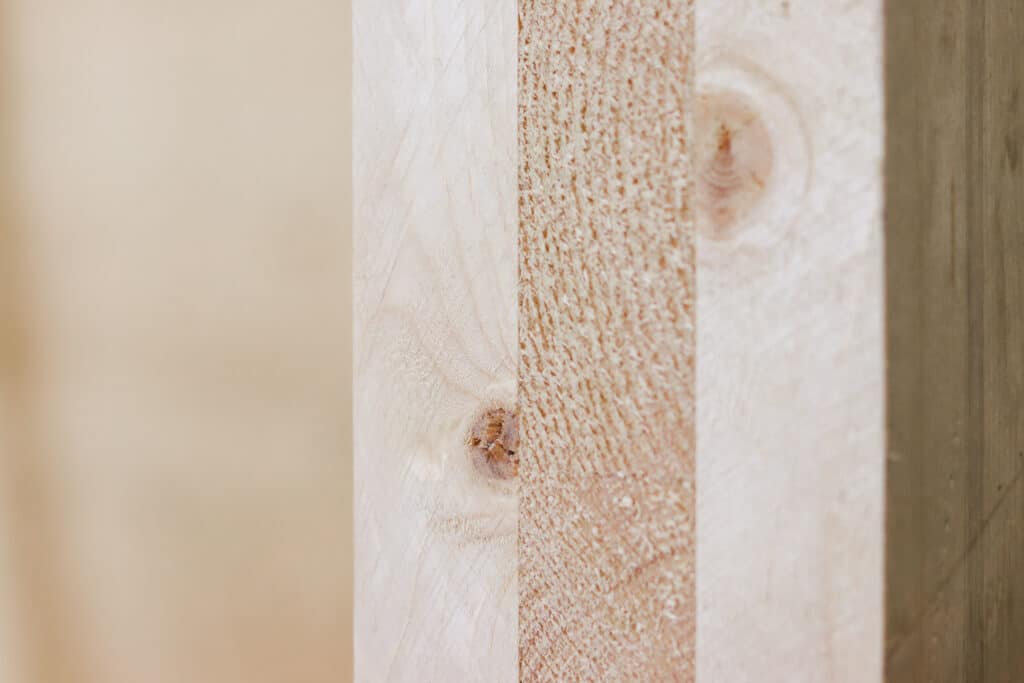
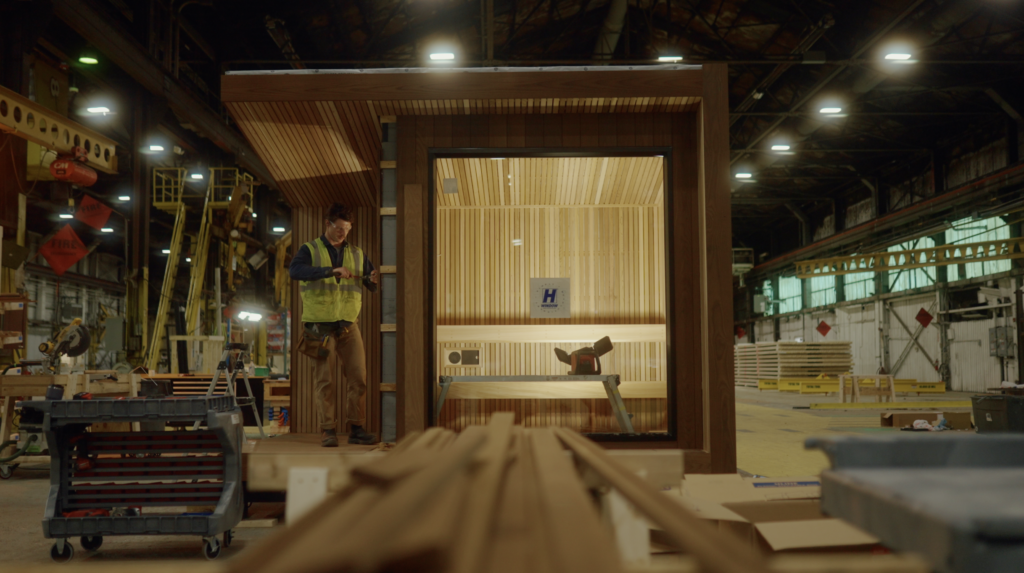
Instead of lightweight walls and foil vapor barriers that create sharp heat and trap moisture, we use cross-laminated timber. CLT behaves like a solid wood wall. It absorbs heat slowly, releases it evenly, and keeps the room calm. Steam stays in the space. The heat feels smoother.
CLT is widely used across Europe and the Nordic countries for buildings that need to handle real weather over time. It’s not experimental. It’s proven.
That stability is why our saunas aren’t something you plan to replace. They arrive fully built, are installed in less than a day, and are meant to stay. People who start with something lighter often end up buying twice.
Sauna works best when it’s treated as permanent from the beginning.

Bring sauna home
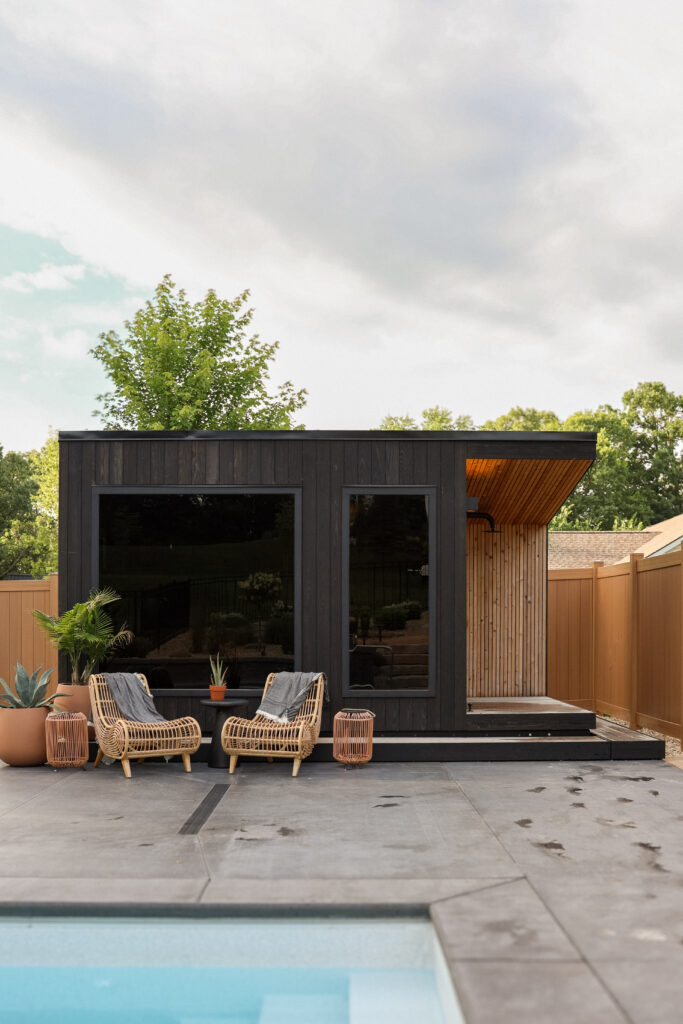
If you’re thinking about a sauna that’s meant to stay, the next step is seeing how one would actually live on your property.
You can design it online, place it in your yard, and get real pricing. Once we see what you’ve put together, we’ll reach out to talk through it and answer any questions that come up. The conversation starts with something concrete, which tends to make it more useful for everyone involved.
Customize yours: https://cedarandstonesauna.com/for-home/