From Finland to Instagram: How Sauna Lost (and Can Regain) Its Meaning
Somewhere between smoke saunas in Finland and perfectly filtered Instagram reels, sauna changed.
What was once a communal ritual rooted in resilience, winter, and togetherness has, in many corners of the internet, become a performance. Timed rounds. Optimized temperatures. Branded “protocols.” Extreme cold plunges. Detox promises.
So we asked a bigger question:
What does the science actually say?
And perhaps more importantly, what have we misunderstood?
In a recent live webinar hosted as part of Finlandia Foundation National’s National Sauna Week, Justin Juntunen, Co-Founder of Cedar and Stone Nordic Sauna, sat down with science journalist and Outlive coauthor Bill Gifford to explore the research, the myths, and the cultural drift of modern sauna.
In the webinar, we explore:
- The evolutionary story of human heat adaptation
- Heat shock proteins and cellular resilience
- The limitations of current sauna research
- The future of sweat bathing in modern culture
You can watch the full conversation here:
Bill’s Unexpected Path to Sauna
Bill did not grow up in Finnish sauna culture. Born in Alabama on a record-cold day and later living in humid Washington, DC, he eventually moved to Utah for the winters and the mountains.
A few years ago, during a particularly heavy winter, he found himself regularly sitting in his local gym’s sauna. It became a place of refuge during a difficult season of life. Quiet. Solitary. Restorative.
Around that same time, he received an assignment to research heat exposure. What started as curiosity evolved into deep scientific exploration and eventually into his new book, Hotwired: How the Hidden Power of Heat Makes Us Stronger.
One of the central ideas of his work:
Humans are built for heat.
We evolved to sweat. With millions of sweat glands across our bodies, our thermoregulation system is not a flaw. It is a superpower. Heat exposure, like exercise, is a stressor that strengthens us when applied wisely.
But as Bill points out, we are not just training muscles in the sauna. We are training our thermoregulatory physiology. And like any system, if we do not use it, we lose it.

What the Sauna Science Actually Says
The Finnish research on sauna is some of the most compelling public health data we have.
Frequent sauna bathing has been associated with:
- Significant reductions in cardiovascular mortality
- Lower risk of Alzheimer’s and dementia
- Improved recovery
- Reduced symptoms of depression
One widely cited study showed that frequent sauna users had dramatically lower rates of heart-related death compared to infrequent users. If a pharmaceutical drug produced similar outcomes, it would dominate headlines.
But here is where things get distorted.
There is no single “perfect” number of minutes.
There is no universal temperature.
There is no magic sequence that unlocks everything.
The influencer version of sauna often turns research into rigid formulas. The Finnish version is far less obsessive. It is integrated into life, not optimized for it.
Bill noted one of the most surprising areas of research: mental health. Some studies suggest sauna may have antidepressant-like effects, with benefits lasting weeks beyond a single session.
Which raises an important point.
The power of sauna may not be primarily about chasing longevity metrics. It may be about regulating the nervous system and supporting emotional resilience.

Detox, Cold Plunges, and the Culture Gap
We also addressed two of the loudest modern claims.
The Detox Question
Does sauna “remove toxins”?
The answer is more nuanced than social media suggests.
Your liver and kidneys handle the majority of detoxification. While sweat contains trace substances, sauna is not a primary cleansing organ.
And yet, many people leave sauna feeling purified.
Why?
Because they have slowed down. They have heated up. They have bathed. They have rested. The sensation of cleansing is real, even if the mechanism is not what marketing implies.
The Case Against Extreme Cold
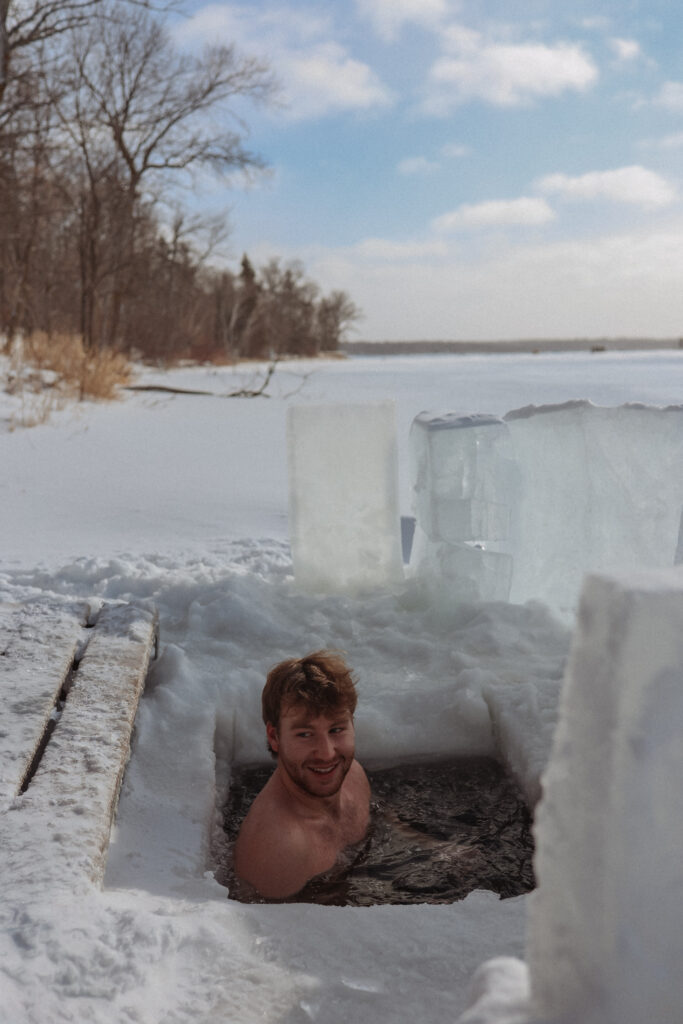
Cold exposure has benefits, particularly for mood and resilience. But many modern cold plunges push temperatures to extremes that are far removed from traditional practices.
Natural bodies of water fluctuate. They are not always set to a punishing number.
Bill described cold immersion as a “bath of surprise.” It can be powerful. But it is not mandatory. And it should not overshadow sauna itself.
Finland vs. Fitness Culture
When Bill visited Finland, what stood out was not optimization. It was atmosphere.
Nobody was timing sessions.
Nobody was tracking heart rate zones.
People were talking. Sitting. Sweating. Resting.
Sauna looked more like date night than a biohacking lab.
In historic saunas like Raijaportti in Tampere or modern urban spaces like Löyly in Helsinki, sauna is relational. It is social. It is cultural.

Contrast that with the American fitness lens, where longevity can sometimes drift toward individual performance and self-optimization.
As Bill put it, the pursuit of longevity without purpose can become hollow.
The better question may be:
Who are you staying healthy for?
Sauna, at its best, keeps us connected. And connection itself is protective.
What We’ve Lost and What We Can Regain
So what has been lost in the Instagram-ification of sauna?
- Simplicity
- Community
- Stillness
- Cultural context
Sauna is not risotto, Bill joked. You can make it a million ways. Structured or unstructured. Social or quiet. Traditional or modern.
But when it becomes purely performative, we miss its core.
Heat is ancient.
Sweat bathing traditions exist across cultures.
Sauna is not a trend.
It is a return.
And if you want to go deeper, pick up Bill’s new book:
Hotwired: How the Hidden Power of Heat Makes Us Stronger